The books
Invoices, bills, VAT, banking and reports. Journals, cashbook, general ledger and trial balance underneath them, and a year end that closes properly, not by starting a new file.
Lumarix is a South African ERP: bookkeeping, bank, selling, buying, stock, payroll and reports, all speaking to each other and all adding up to the cent. It runs in your browser and on your phone. It is the first product on Dachshund, and unlike the platform underneath it, this one you can use today.
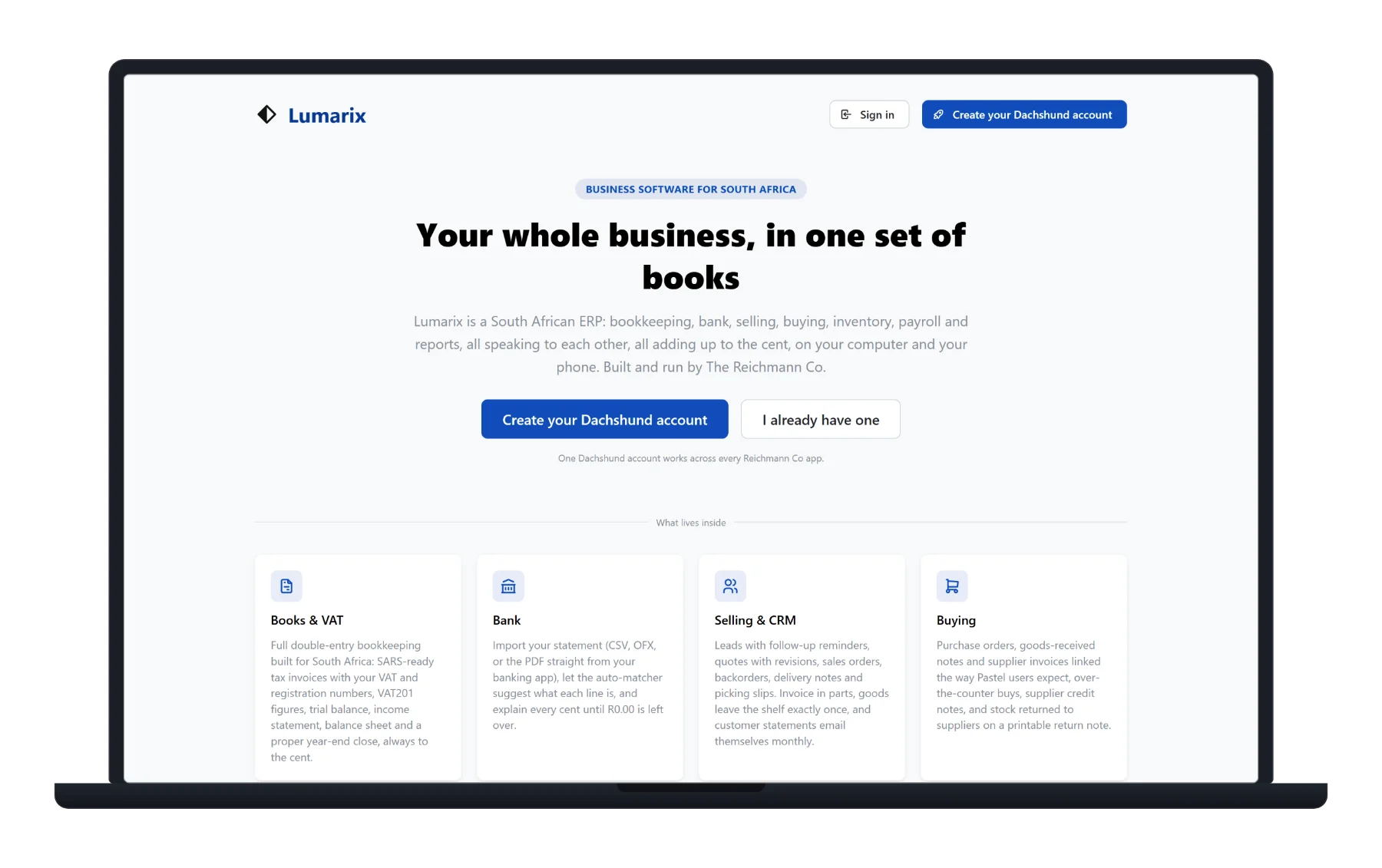
Most small businesses run their money across four things that do not know about each other: a spreadsheet for quotes, an invoicing tool, a bank statement in a download folder, and a bookkeeper who reconciles all three once a month and finds out in the third week what happened in the first.
The cost of that is not the software licences. It is that nobody can answer a simple question quickly. What did that job actually make. Whether the stock figure is real. Whether the VAT number about to be filed came from the same records as the invoices. Each answer takes somebody a morning, and every morning it takes is a morning nobody spends on the business.
Lumarix is one system for all of it. A quote becomes an order, an order becomes a delivery, a delivery becomes an invoice, and the invoice lands in the ledger without anybody retyping it. The stock moves when the delivery goes out. The payslip posts to the books when the pay run closes. The bank statement comes in and matches itself against what is already there.
Because it is one system, the reports are not an assembly job. The trial balance, the income statement and the VAT figures come off the same records as the documents, so they agree by construction rather than by somebody checking. That is the whole point of the thing, and it is the part that is hardest to bolt on afterwards.
It sits on Dachshund, which handles the account, what your company is licensed for, and the billing. That is why the sign-in says Dachshund account rather than Lumarix account: one login for this and for whatever we make next.
Each part is licensed on its own, so you can hold the ones you use. They are not separate programs, and there is no export step between them.
Invoices, bills, VAT, banking and reports. Journals, cashbook, general ledger and trial balance underneath them, and a year end that closes properly, not by starting a new file.
Leads, quotes, orders and deliveries, in that order and each one carrying into the next. Credit notes, receipts and refunds where the money has to go back.
Purchase orders and goods received, matched against the bill when it arrives so you find the difference at the point it happens, not at month end.
Items, receiving, issuing, counts and costing. More than one location, stock takes that reconcile, and costs that stay honest when a sale goes through before the delivery lands.
Payslips, PAYE, UIF, leave and year end. EMP201, and the year-end paperwork that has to agree with what the pay runs actually did.
Dashboards and reports across all of the above, on screen, on paper and in a spreadsheet. Budgets against actuals, and figures you can click through to the entry behind them.
No tiers, no feature gates that unlock at a higher plan, and no quote to sit through before you can see a number.
Create a Dachshund account and ask for the free month. If you would rather talk to a person first, or you want to know whether it fits how your business actually works, say so and we will answer, including if the answer is no.